Purdue Biofuels Consortium to bring biodiesel, ethanol blends to diesel engines

Most agricultural tractors use petroleum-based diesel fuel—even though a significant amount of the corn they are harvesting goes toward making ethanol.
Could tractors start using ethanol as fuel? That’s the project being tackled by Purdue University, John Deere, Cummins and a consortium of biofuel producers.
“A third of all the world’s corn is grown in the United States, most of it here in the Midwest,” said Greg Shaver, a professor of mechanical engineering at Purdue. “About 40 percent of that corn goes to ethanol production. So why are the machines that are harvesting it being fueled with diesel, which is petroleum-based? They should be using a fuel that’s close to home.”
Danan Dou, the chief technologist for John Deere Power Systems, said, “We have worked with Purdue for more than 10 years. We’ve had several projects at Herrick Labs focused on making engines more efficient. Our latest initiative is all about using a blend of biofuels in diesel engines.”
There are three primary kinds of plant-based fuel that will be studied by the consortium:
Ethanol, which largely comes from corn fermentation.
Biodiesel, derived from animal fats and vegetable oils like soybeans.
Renewable diesel, which uses a more resource-intensive refinement process but results in a one-to-one replacement for petroleum diesel.
These fuels excel at different applications.
Biodiesel is designed for compression engines, but ethanol is less viscous and has better cold flow properties.
It is also generated at large scale around the country.
“They are so complementary to each other, and soluble in each other,” Dou said. “It would be ideal if we could blend them and get the best of both worlds.”
Shaver said, “Diesel engines are compression engines, not spark-ignited engines. What makes ethanol a great fuel for spark-ignited engines makes it very difficult to use by itself in compression-ignition engines. What we’re trying to do is make a biodiesel and ethanol fuel mix work in a diesel engine, without having to heavily modify the existing engine.”
Purdue and Deere have teamed up to launch the Purdue Biofuels Consortium.
This three-year collaboration brings together prominent engine manufacturers like John Deere and Cummins with biofuel producers, including Poet, the world largest bioethanol producer; Ag Processing Inc., a leading agribusiness cooperative and biodiesel producer; Marquis Energy, which generates more than 395 million gallons of low-carbon fuel annually; and Growth Energy, a leading biofuel trade association.
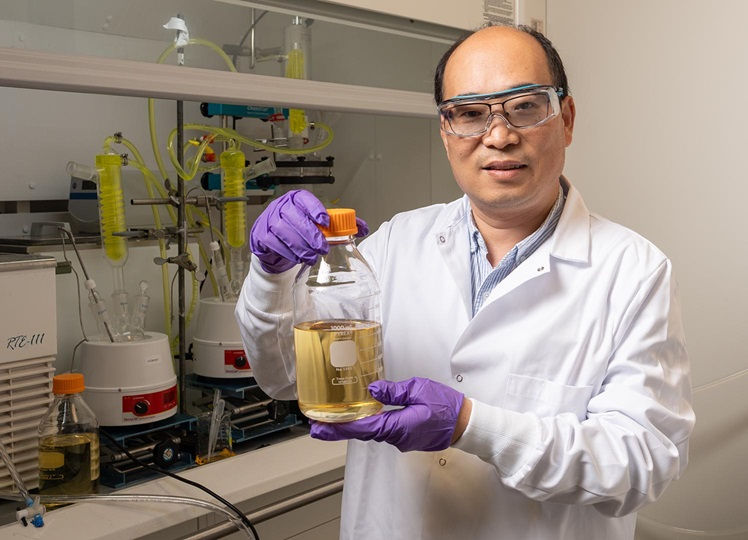
Charter researchers from Purdue also include Eric Holloway, professor of engineering practice in mechanical engineering, and Junli Liu, a senior research scientist in agricultural and biological engineering.
Threefold approach
“This project has three important approaches,” Dou said. “First is the engine side, which I’ve worked on with Dr. Shaver. The second is the fuel side, which Dr. Holloway and Dr. Liu study in addition to our fuel-producing partners. And the third is the business side. We all have different stakeholders, but we are working toward the same goal. We want engines that are capable of burning ethanol-biodiesel blends, a fuel blend that is readily available, and a customer base that is motivated to use the solution.”
Shaver said, “It’s important to tackle this from all sides. Biofuel producers have incentive to increase production if they have more of a market, and engine manufacturers like Deere and Cummins have incentive to offer more options to their customers. And of course many Midwestern states stand to benefit, because corn production will become even more valuable than it already is.”
There is precedent to this journey: Consumer-based road vehicles began to experiment with flex-fuel options in the 1990s.
“Our first use of ethanol was in specialty vehicles,” Dou said. “Then we started introducing it to gas pumps in small percentages. Now, all gas-powered passenger vehicles from model year 2001 onward are approved by the EPA to use E15, which is gasoline mixed with up to 15 percent ethanol. This has saved millions of gallons of petroleum and created an additional source of demand for farmers.”
The benefits are obvious: increased economic opportunity for farmers and decreased carbon emissions for the environment.
But Shaver said the benefits also ripple out to national security.
“Important ingredients required to make petroleum-based diesel fuel comes from other countries, and as we’ve seen with recent global conflicts, fuel volatility can happen at any moment,” he said. “The more fuel security we can have within our own borders, the more we can reduce our reliance on overseas sources.”

The long road
Based on their research up to this point, diesel engines currently need special sensors and other infrastructure to be able to adjust to these new fuel mixtures with high ethanol content.
But ultimately, backwards compatibility is the dream.
“If you can put a fuel into your engine without worrying about what kind of blend it is, and without having to install any additional hardware, that’s the ultimate end goal,” Dou said. “Even a 10 percent ethanol mixture would be a game changer in both the diesel-engine industry and the biofuel industry.”
Shaver said, “Our end goal is that Deere and Cummins can offer these engines as options—either for new customers, or as aftermarket kits. New engines would be fuel-agnostic, seamlessly running on diesel, biodiesel or biodiesel plus ethanol. And hopefully even the oldest diesel tractor can be retrofitted to accept a mix of fuels, offering economic flexibility for farmers.”
Shaver explained why he is motivated to pursue this work.
“The price of everything is going up, so we want to reduce the economic stress on our farmers and other heavy-equipment operators,” he said. “Ethanol-based fuel blends might be less expensive one week, so they might want to use a higher mix of that. Or other weeks, straight biodiesel would be more economical. We want to empower them to make that choice.”
Dou says that a broad consortium of partners will ultimately result in the best outcome.
“We are very intentional about forming these partnerships across the board,” he said. “This is not intended to be a proprietary project for Deere or Cummins. We want these potential engine advances to be used by everyone—because then everyone will benefit. It may take years to get there, but the end goal will make the journey worth it.
He said Purdue is an ideal partner for this project.
“Not only do they have a world-class engineering program, they also are well known for agriculture,” Dou said. “It’s great to be able to speak both languages and have it all in one place.”