Higher blending targets drive RIN prices close to record highs
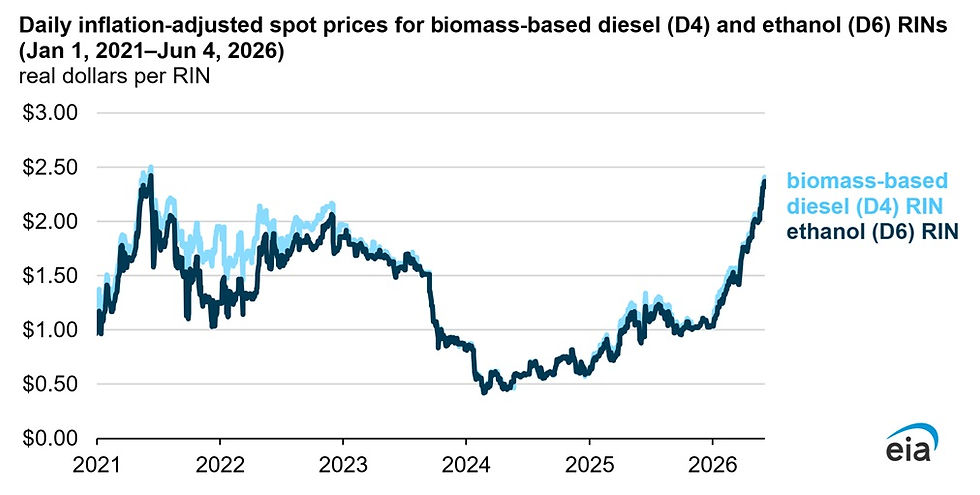
Compliance credits for biomass-based diesel and ethanol have doubled in value since the start of this year.
The credits, known as renewable identification numbers (RINs), have increased in price, mostly because of higher U.S. biofuel blending targets.
The combination of high RIN prices and rising motor gasoline and diesel fuel prices has created an especially favorable market for producing and blending biofuels.
RINs are credits generated when biofuels are produced or imported and are used to comply with the Renewable Fuel Standard program.
Under the RFS, the U.S. EPA sets annual renewable volume obligations (RVOs) for the minimum volume of biofuels that must enter the U.S. fuel supply.
Obligated parties—petroleum refiners and motor gasoline and diesel importers—comply either by blending biofuels into petroleum-based fuels or by purchasing RIN credits.
As of June 4, biomass-based diesel (D4) RINs traded at $2.41 and ethanol (D6) RINs traded at $2.37, both close to their all-time highs set in 2021.
Because one gallon generates 1.5 RINs for biodiesel and 1.6 RINs to 1.7 RINs for renewable diesel, these fuels currently generate more than $3.50 per gallon of credits.
A gallon of fuel ethanol generates 1 credit.
RIN prices increased in 2026 primarily because of higher blending mandates.
On March 27, the EPA announced the final RFS rule for 2026-’27, establishing significantly higher RVOs than in 2025.
RIN prices increase with high RVOs to reflect the higher profit margins biofuel producers need as incentive to produce enough fuel to meet mandates.
Higher prices for petroleum products make fuel ethanol relatively more attractive to blend into gasoline.
Relative to motor-gasoline prices, the U.S. Gulf Coast fuel ethanol price, adjusted for energy equivalence, has been lower most days since mid-March.
The higher RIN value that blenders using ethanol can then sell on the open market to companies that need to remain in compliance also incentivizes more blending into gasoline.
The fuel-ethanol discount to gasoline has been more than $2 a gallon in May and June when adding in the higher RIN value.

High RIN values have also supported production and blending margins for biodiesel and renewable diesel.
The difference between soybean-oil and heating-oil prices, the Bean Oil-Heating Oil spread, reflects the profitability of blending biodiesel and renewable diesel without incentives.
Typically, RIN prices move with the BOHO spread to maintain margins.
When RIN values increase relative to the BOHO spread, however, as they have done in 2026, profit margins for producing biodiesel and renewable diesel generally improve.
The rapid increase in RIN values relative to the BOHO spread in 2026 suggests that the new RVOs are a significant driver of increased RIN values and that biodiesel and renewable diesel production margins are much higher than in 2025.

The U.S. Energy Information Administration forecasts record-high production of fuel ethanol and renewable diesel in 2026 because of high blend mandates, high gasoline and diesel prices, and increasing production capacity at biofuel plants.
Biodiesel production also increases, although EIA projects it will remain below record highs because of lost production capacity.
EIA predicts fuel-ethanol production will increase by 2 percent in 2026, with the fuel-ethanol share of motor gasoline consumption at 10.7 percent, compared with 10.5 percent in 2025.
EIA projects that renewable diesel production will increase by 24 percent and biodiesel production by 41 percent in 2026, compared to 2025.
It forecasts production of all three fuels to increase further in 2027 when the RVO increases again.