European Biodiesel Board publishes its ‘2025-’26 Statistical Report’
The European Biodiesel Board announced June 8 that it has published its “2025-2026 Statistical Report,” providing a comprehensive overview of biobased diesel production, consumption, feedstock use and trade developments across the EU.
As the leading industry association for European biodiesel, renewable diesel and sustainable aviation fuel (SAF) producers, EBB said its report offers insights into the role of biobased diesel and SAF in meeting the EU’s energy and climate goals.
The report also reaffirms that EBB represents around 65 percent of the EU’s biobased diesel and SAF output.
“The last years, even weeks, have exposed the vulnerabilities of Europe’s energy supply,” said EBB Secretary General Xavier Noyon. “The EBB will reiterate what it has said for years—energy security and climate policy should not be separate conversations. Reducing dependence on imported fossil fuels is not only a climate imperative but a geopolitical one. Biodiesel production, rooted in Europe, provides an outlet for European agriculture production, waste-collection systems and industrial capacity. FAME, HVO and HEFA production reinforces Europe’s strategic autonomy.”
Plateau in production
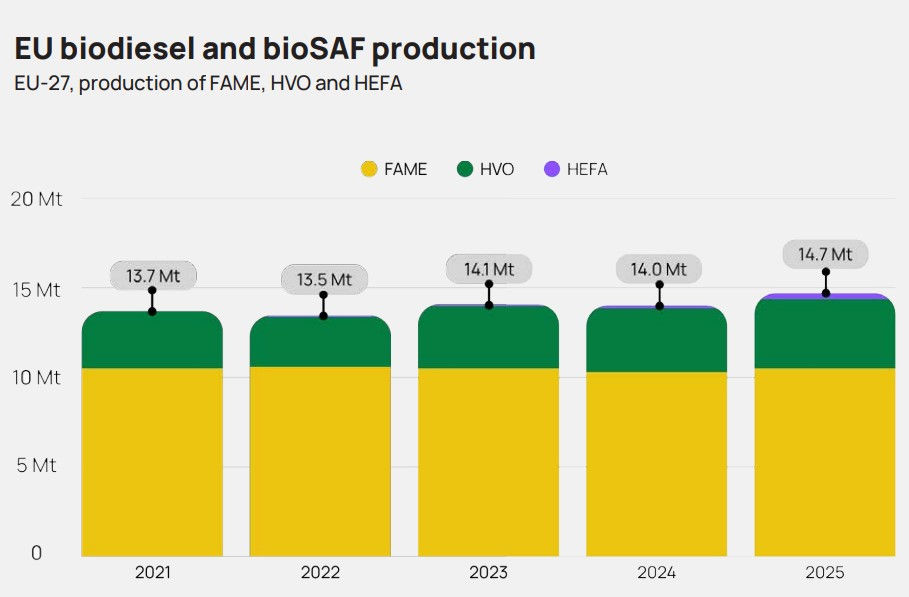
Total EU-27 production of biobased diesel and SAF rose slightly to 14.7 million metric tons in 2025.
While FAME maintained its dominant market position at 10.5 million tons, HVO saw moderate and steady growth to 3.9 million tons.
HEFA, a type of sustainable aviation fuel, demonstrated the most significant relative expansion, scaling rapidly from negligible levels a few years ago to 0.30 million tons in 2025, effectively doubling year-on-year.
At a time when renewable fuel volumes must scale up significantly to meet the EU’s 2030 climate targets, the growth in domestic production is minimal.
While there are a multitude of explanations possible for this stagnation, and the hesitations to invest in expansion, policy uncertainty and regulatory complexity play key roles.
Feedstock mix
The report reaffirms the continued importance of crop-based biofuels in Europe’s renewable energy mix, with rapeseed oil remaining the dominant feedstock.
This trend underscores the essential role of first-generation biofuels in providing reliable, domestically sourced renewable energy, while contributing to agricultural market stability and rural development.
At the same time, a key development highlighted in the report is the growing share of Annex IX waste-based feedstocks (55 percent), which is now superseding crop-based biodiesel (38 percent) in overall production.
The shift to waste-based largely signifies to the diversification of the feedstock mix, likely resulting in enhanced greenhouse-gas (GHG) savings across the sector.
Trade
The EU imported in 2025 about 1.76 million tons of HVO and about 1.54 million tons of FAME.
Imports of FAME declined about 22 percent vs. 2024.
“In 2025 we saw the introduction of an EU customs code for HVO allowing—for the first time—more detailed tracking of HVO imports through Eurostat data,” EBB stated. “Following the EBB-led antidumping campaign against dumped Chinese biodiesel imports, inflows from China plummeted dramatically. China dropped from being the EU’s top biodiesel supplier in 2024 to representing just 1 percent of receipts in 2025, falling from 1.07 million tons in 2023 to a mere 0.16 million tons in 2025.”
To read the report, click here.