Denali reports 70% average increase in food diversion at stores adopting depackaging technology
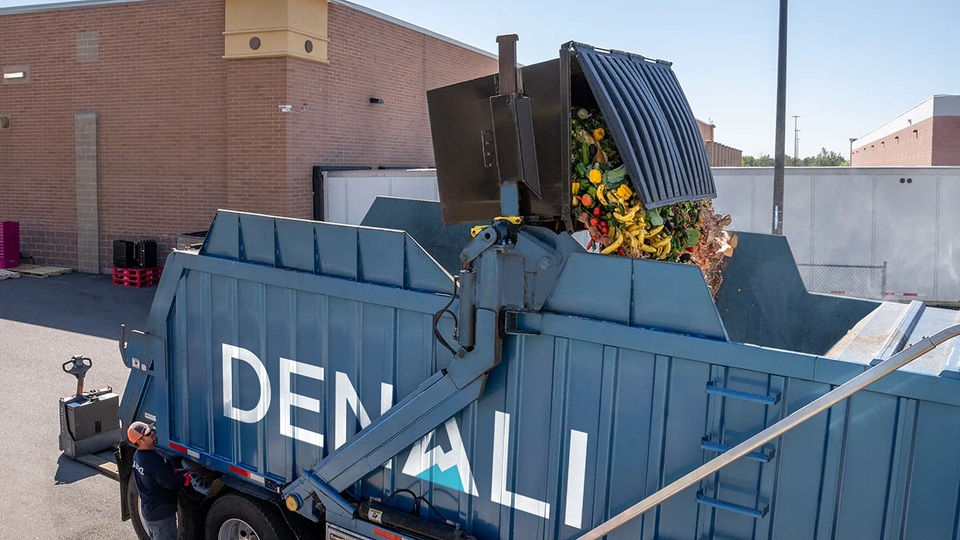
Denali, the nation’s largest recycler of food and organics, reports that grocery stores transitioning from manual food separation to its depackaging technology increased the volume of food diverted from landfill disposal to recycling by an average of 70 percent, according to the company’s 2025 sustainability report.
The finding is based on data from more than 3,300 U.S. stores.
The depack-program findings are one example of Denali’s broader work to recover inedible food and organic materials and return them to productive use.
Across its operations, Denali managed 14.8 billion pounds of organic materials in 2025, including 1.35 billion pounds of uneaten food.
The report also highlights Denali’s work enhancing nutrient recovery, resilient agriculture and biodiesel production.
“Businesses need a practical and cost-effective way to keep unused food out of landfills and know with confidence what happens after it’s collected,” said Denali CEO Todd Mathes. “Our nationwide direct-service capabilities, owned recycling operations and diverse partner network maximize landfill diversion and deliver value to our customers. The 2025 sustainability report results reinforce our focus on making food recycling a dependable part of everyday operations, with less manual work for employees and data that helps customers track their progress and improve managing inventory.”
How Denali helps businesses divert food waste from landfills
Denali pairs commercial food and organics collection with recycling services for grocers, restaurants, food manufacturers and processors, municipalities, convention centers, and other food-related businesses.
Food recycling complements food-waste prevention and donation efforts by creating renewable products from food that can no longer be consumed.
The depack program expands these opportunities by mechanically separating unsellable food from its packaging, reducing the need for manual labor and making food diversion more practical at scale.
Denali’s ReCirculate™ compost is made from unsold food collected from grocery partners and sold on store shelves, demonstrating the circular economy in action for retailers.
Launched in January 2025 in partnership with Walmart, ReCirculate is now available at 1,000 stores across the U.S., according to the report.
Denali estimates that ReCirculate sales over the past year were equivalent to enriching 10,000 home gardens.
What Denali turns uneaten food, organic materials into
In 2025, Denali served more than 13,000 customer locations across 48 states and Puerto Rico through its own operations and a nationwide network of animal feed, composting and renewable energy processing facilities, recycling 97 percent of all organics collected by the company.
Uneaten food, plant and wood biomass is used to create compost, soils and mulch.
Food-processing residuals are beneficially reused as natural fertilizer and used cooking oil is transformed into biodiesel.
Using byproducts from food manufacturers, distribution centers, bakeries and grocery stores, Denali repurposes these valuable high-starch organic materials into nutrient-rich animal feed.
In some cases, it collects and transports food directly to farms to feed livestock.
It also manufactures high-quality animal feed.
Last year, Denali created 479 million pounds of feed.
Denali provided more than 15 million pounds of nitrogen to over 500 farmers through its natural fertilizer program, saving farming partners an estimated $9 million compared with traditional fertilizers in 2025.
These savings were critically important to farmers as the USDA projects national spending on fertilizer, lime and soil conditioners to increase 15.3 percent in 2026.
The company also serves restaurant and food-service businesses by collecting and recycling used cooking oil and grease, transforming these materials into renewable fuel.
In 2025, Denali converted these materials into approximately 12.1 million gallons of biodiesel, returning them to productive use as renewable fuel.